Do I need Travel Health Insurance for Germany? A guide for every visa type
Written by Japveer Arora, IHK-certified insurance broker (§ 34d GewO)
Published 18 September 2026
Perhaps you are travelling to Germany for a vacation. Or maybe you are moving to Germany to study or to work. In most cases, you require a travel health insurance before you can get a visa. There are different names for these policies: Travel Health Insurance, Reisekrankenversicherung, Incoming Travel Health Insurance, Expat Travel Health Insurance, Langzeit-Auslandsreisekrankenversicherung. In the following sections, we explain when you need a travel health insurance and which type suits your specific situation.
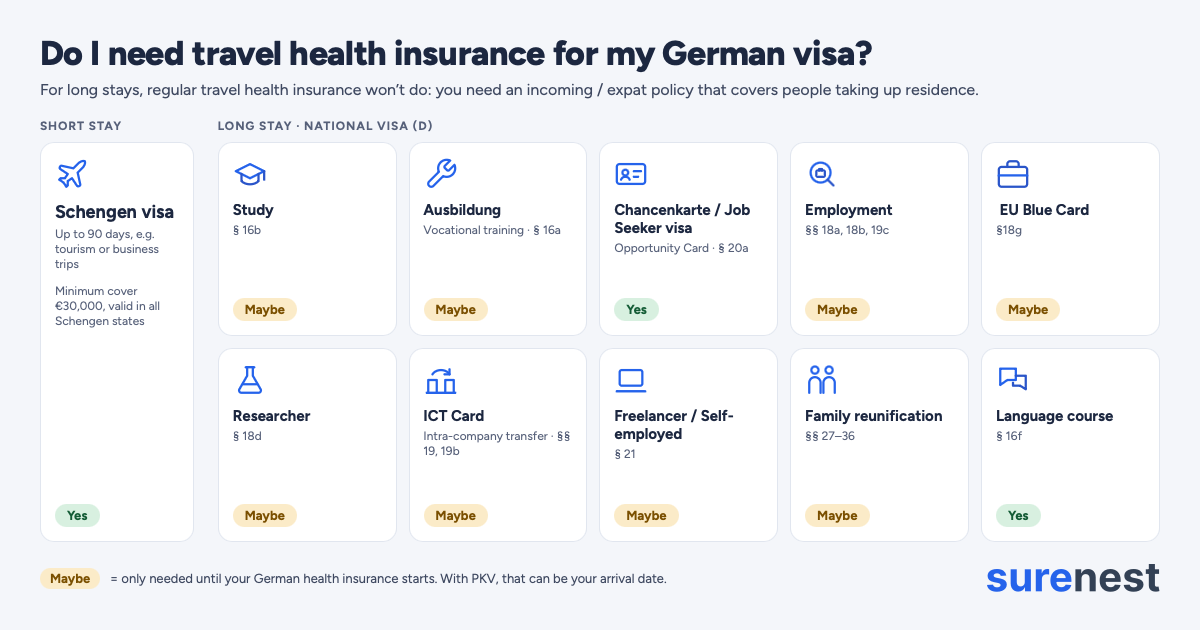
Do I need a travel health insurance for a vacation in Germany?
If you come from an Annex II country such as US, UK, Canada, Australia, Japan, South Korea, Brazil and many others, you don’t need a Schengen visa and hence, travel health insurance is not mandatory. Nonetheless, we recommend it since emergency medical treatment and repatriation can be very expensive. Paying a small amount for travel health insurance is worth covering the risk.
If you come from an Annex I country, you need a Schengen visa to travel to Germany. To get a Schengen visa, one needs to submit proof of travel health insurance. This travel health insurance must meet the following requirements as per the Article 15 of the Regulation (EC) No 810/2009.
- Repatriation for medical reasons.
- Urgent medical attention and/or emergency hospital treatment or death.
- The policy should be valid in all member states and cover the entire period of the person’s intended stay or transit.
- The minimum coverage shall be EUR 30,000.
- Holders of diplomatic passports are exempt from holding travel insurance.
Do I need travel health insurance to study in Germany?
If you are moving to Germany to study, you can opt for either PKV or GKV. If you opt for PKV, your PKV cover can start from your date of arrival. In this case, you don’t need a separate travel health insurance. If you opt for GKV, your GKV start date is legally defined as your enrolment date or the semester start at the university (§ 186 Abs. 7 SGB V), whichever is later. Your GKV Krankenkasse will confirm the start date in writing. But you need to get travel health insurance which covers you from your date of arrival until your GKV cover starts. The conditions for this travel health insurance are slightly different from the travel health insurance for the Schengen visa. The requirements for the travel health insurance are defined in “Lebensunterhalt bei nationalen Visa”, section 2.4, Stand 09/2025. These are:
- The travel insurance should be valid in Germany.
- The policy must not exclude cover for people taking up or planning to take up residence (Wohnsitznahme). Ordinary travel insurance policies regularly contain this exclusion.
- The policy should be valid until your GKV cover kicks in; in some cases the embassies ask for a three-month cover. Check on the website of your country’s embassy in case they have a specific requirement.
- The start of cover may not be made conditional on anything (for example: opening a German bank account).
- A resolutive clause such as “cover ends when the person is admitted to German statutory health insurance” is acceptable.
In GKV and PKV, students benefit from the student tariffs, which are cheaper. In GKV, the student rates are not available to everyone. People over the age of 30 need to pay higher GKV rates apart from a few exceptions (§ 5(1) no. 9 SGB V). In PKV, student tariffs are available up to around age 39 or until the end of studies, but the specifics vary by provider and tariff.
Do I need travel health insurance to do an Ausbildung in Germany?
Starting an Ausbildung (vocational training) in Germany is treated similar to starting an employment, when it comes to health insurance. In this case, you are compulsorily insured in GKV. Your GKV cover starts on your Ausbildung start date (§ 186 Abs. 1 SGB V). You need to get travel health insurance which covers you from your arrival date until the Ausbildung start date. The requirements for the travel health insurance are defined in “Lebensunterhalt bei nationalen Visa”, section 2.4, Stand 09/2025. These are:
- The travel insurance should be valid in Germany.
- The policy must not exclude cover for people taking up or planning to take up residence (Wohnsitznahme). Ordinary travel insurance policies regularly contain this exclusion.
- The policy should be valid until your GKV cover kicks in; in some cases the embassies also ask for a three-month cover. Check on the website of your country’s embassy in case they have a specific requirement.
- The start of cover may not be made conditional on anything (for example: opening a German bank account).
- A resolutive clause such as “cover ends when the person is admitted to German statutory health insurance” is acceptable.
Do I need travel health insurance if I am coming to Germany through the Chancenkarte (Opportunity Card) or Job-Seeker visa (§ 20a)?
With the Chancenkarte or the job-seeker visa, you won’t be eligible for GKV until you start your employment in Germany. In the absence of a job offer, PKV providers would also reject you for a comprehensive private health insurance (PKV). The suitable health insurance policy for this scenario is the expat insurance (Langzeit-Auslandsreisekrankenversicherung) which is valid for one-year or for the period of the visa. The requirements for the travel health insurance are defined in “Lebensunterhalt bei nationalen Visa”, section 2.4, Stand 09/2025. These are:
- The travel insurance should be valid in Germany.
- The policy must not exclude cover for people taking up or planning to take up residence (Wohnsitznahme). Ordinary travel insurance policies regularly contain this exclusion.
- The start of cover may not be made conditional on anything (for example: opening a German bank account).
- A resolutive clause such as “cover ends when the person is admitted to German statutory health insurance” is acceptable.
Do I need travel health insurance if I am coming to Germany for employment through EU Blue Card / National Visa (D) / Employment Visa?
If you are moving to Germany for employment: § 18a — skilled worker with vocational training, § 18b — skilled worker with a university degree, § 18g — EU Blue Card, § 19c — employment that doesn’t require skilled-worker status, based on the Beschäftigungsverordnung; you need to be compulsorily insured in statutory health insurance (GKV) if you earn below the Jahresarbeitsentgeltgrenze (JAEG). The JAEG in 2026 is €77,400. If you earn above the JAEG, you are also eligible for PKV, but many PKV providers require you to have residence in Germany as well as prior health insurance in Germany / EU / EEA to fulfil the deutsche Vorversicherungszeit requirements. With PKV, your insurance cover can start on the day you arrive in Germany and you don’t need to separately get travel health insurance.
If you opt for GKV, your GKV cover can legally start only from your first day of employment (§ 5(1) with § 186 SGB V). You need to have travel health insurance to cover you from the date of your arrival until your employment starts. The requirements for the travel health insurance are defined in “Lebensunterhalt bei nationalen Visa”, section 2.4, Stand 09/2025. These are:
- The travel insurance should be valid in Germany
- The policy must not exclude cover for people taking up or planning to take up residence (Wohnsitznahme). Ordinary travel insurance policies regularly contain this exclusion.
- The policy should be valid until your GKV cover kicks in; in some cases the embassies also ask for a three-month cover. Check on the website of your country’s embassy in case they have a specific requirement.
- The start of cover may not be made conditional on anything (for example: opening a German bank account).
- A resolutive clause such as “cover ends when the person is admitted to German statutory health insurance” is acceptable.
If you are eligible for both GKV and PKV and are unsure, which one is the better choice for your situation, you can use the calculator on our website to calculate your projected premiums in both systems.
Do I need travel health insurance if I am coming to Germany as a researcher § 18d?
If your research position comes with an employment contract, this works like the employment section. If you’re scholarship-funded, you aren’t compulsorily insured but can join the GKV voluntarily (§ 9(1) no. 6 SGB V). In this case, the cover starts on the day you join the GKV Krankenkasse (§ 188 SGB V). Until this date, you need travel health insurance, which covers you from the date of your arrival until your membership starts in GKV. The requirements for the travel health insurance are the same as listed in the employment section.
Do I need travel health insurance if I am coming to Germany as an ICT card holder (§§ 19/19b)?
ICT cards (§§ 19/19b) are intra-company transfers. A posted worker may stay insured in their home system under an A1 certificate or a bilateral social security agreement, in which case German GKV never kicks in. If neither of those two options apply for you, you need to be insured in GKV or PKV. In this case, the requirements for the travel health insurance as the same as listed in the employment section.
Do I need travel health insurance if I am coming to Germany as a freelancer / self-employed professional (§ 21)?
For someone coming to Germany as a freelancer/self-employed professional, GKV membership is possible through two routes. One, if you are an artist or a publicist, you might be eligible for GKV via the Künstlersozialkasse (KSK). Second, you might be eligible to be voluntarily insured in GKV, if you fulfill the vorversicherung requirements in another EU / EEA or a treaty country. Under Vorversicherung requirements, you need to have prior health insurance before you can take up voluntary GKV membership. If these two paths don’t apply to you, you most likely can’t be insured in GKV.
PKV is an option but PKV providers also reject members without prior insurance history in Germany. They may also require a proof of your residence permit and prior health checks, before they take you as a member.
If GKV and PKV is not an option for you, you can consider an expat / incoming travel health insurance. Once you live in Germany, the law (§ 193(3) VVG) requires you to have a health insurance which meets German standards. Expat / incoming travel health insurance policies don’t meet them. But if you are unable get GKV or PKV cover, consulates can accept expat / incoming policies since they meet the requirement of adequate health insurance for your visa application under § 2(3) AufenthG. But this depends on the consulate and is not a foolproof health insurance policy for your visa application. If you don’t qualify for GKV or PKV and need to apply for expat / incoming policy, make sure that it meets the following requirements:
- The policy should be valid in Germany.
- The policy must not exclude cover for people taking up or planning to take up residence (Wohnsitznahme). Ordinary travel insurance policies regularly contain this exclusion.
- The start of cover may not be made conditional on anything (for example: opening a German bank account)
- Since your self-employment is not subject to compulsory insurance under GKV, the health risks associated with your employment activity should also be covered by the policy.
- The cover should be valid for the validity period of the visa.
Once you arrive in Germany with the expat / incoming policy and have a registered address, this unlocks insurers which wouldn’t take you before. Consider switching to a policy which is equivalent to PKV/GKV. This becomes especially important once your visa is up for renewal.
Do I need travel health insurance if I am coming to Germany on a family reunification visa?
As per § 10 SGB V, family insurance in GKV starts when you take up residence in Germany and your family member in Germany is insured in GKV. Taking up residence means that you do an Anmeldung. In this case, you need to cover yourself from your arrival in Germany until your GKV comes into effect after the Anmeldung. For this, you also need to take an expat / incoming policy which meets the following requirements as per “Lebensunterhalt bei nationalen Visa”, section 2.4, Stand 09/2025:
- The travel insurance should be valid in Germany.
- The policy must not exclude cover for people taking up or planning to take up residence (Wohnsitznahme). Ordinary travel insurance policies regularly contain this exclusion.
- The policy should be valid until your GKV cover kicks in; in some cases the embassies also ask for a three-month cover. Check on the website of your country’s embassy in case they have a specific requirement.
- The start of cover may not be made conditional on anything (for example: opening a German bank account).
If your family member is insured in PKV, family insurance doesn’t apply. You’ll either be added to their PKV policy or need your own. Ask their PKV insurer before you travel. Your cover can usually start on your arrival date, in which case you don’t need separate travel health insurance at all.
Do I need travel health insurance if I am coming to Germany for a language course (§16f)?
People coming to Germany for a language course are not students in the legal sense. So, they don’t qualify for GKV or PKV student cover (§ 5(1) no. 9 SGB V). They need to get an expat / incoming travel insurance which meets the following requirements as per as per “Lebensunterhalt bei nationalen Visa”, section 2.4, Stand 09/2025:
- The travel insurance should be valid in Germany.
- The policy must not exclude cover for people taking up or planning to take up residence (Wohnsitznahme). Ordinary travel insurance policies regularly contain this exclusion.
- The start of cover may not be made conditional on anything (for example: opening a German bank account).
- The cover should be valid for the validity period of the visa.
In most cases, travel health insurance is necessary to get a visa. In others, it is a nice-to-have and gives you peace of mind. Travel health insurances also come in different forms: coverage level – basic vs premium, different validity periods – single trip vs multiple trip vs longer temporary stay, geograhical validity – country specific vs worldwide validity. In this article, we explained which travel insurance you might need for your situation so that you can pick the right cover.
Want to discuss your situation with us? Book a free 15-minute call.