TK vs private health insurance (PKV) in Germany
Written by Japveer Arora, IHK-certified insurance broker (§ 34d GewO)
Published 3 September 2026
If you are currently insured with Techniker Krankenkasse (TK) and earn above the €77,400 JAEG (Jahresarbeitsentgeltgrenze) in 2026, you can continue being voluntarily insured with TK or switch to private health insurance (PKV). For a young expat staying in Germany for five years, PKV can cost substantially less; for a family with a single working parent planning to retire here, GKV can be cheaper over a lifetime. Your health, age, family situation, income trajectory, length of stay and retirement plans determine the answer.
Decision Matrix: How can you think about your situation?
| Your Situation | Key Considerations |
|---|---|
| Single, with children or planning children | Total health insurance costs for future family in TK vs PKV, number of planned children, does the partner work |
| Single, no children and no plans to have any | PKV vs GKV cost, desired medical coverage: do you want more than what GKV has to offer |
| Married, non-working partner1, with children or planning to have them | Free GKV family insurance for non-working partner and children |
| Married, working partner, with children or planning to have them | Free GKV family insurance for children, total household health insurance costs in TK vs PKV |
| Married, non-working partner1, no children and no plans to have any | Free GKV family insurance for non-working partner |
| Married, working partner, no children and no plans to have any | Each partner’s health insurance cost in TK vs PKV |
In short: Staying with TK tends to become more attractive when free family insurance is valuable to you or when you expect to live in Germany long term. PKV can be particularly attractive for some healthy, high-earning individuals with fewer family-insurance needs or a shorter stay in Germany. But health history, age, future family structure and lifetime cost can change the result.
Check the details of your situation below.
Considerations before you switch to PKV
The decision to switch is a personal one and varies, depending on one’s situation. But there are some factors that everyone should consider before they make a switch to PKV.
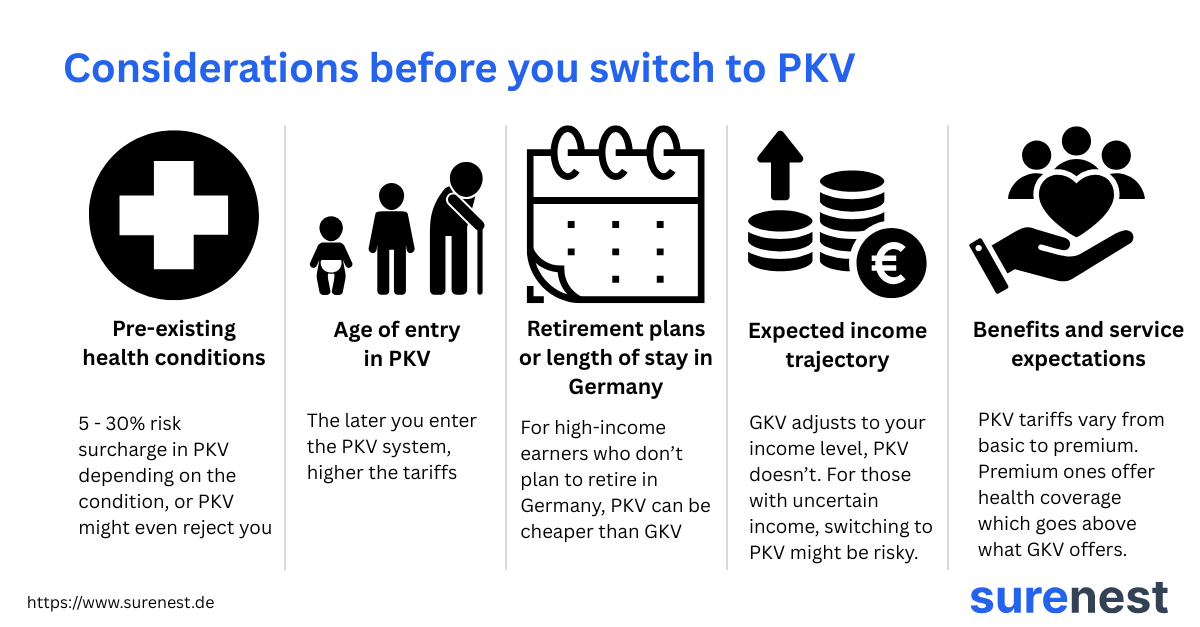
- Pre-existing health conditions
- Age of entry in PKV
- Retirement plans or length of stay in Germany
- Expected income trajectory
- Benefits and service expectations
Pre-existing health conditions
If you suffer from a pre-existing health condition, PKV providers are likely to impose a risk surcharge of 5 - 30% depending on the condition or deny you coverage altogether. Common examples of pre-existing health conditions include asthma, high BMI, Hashimoto’s disease, drug allergies, diabetes, kidney stones, elevated uric acid, migraine, psoriasis, past psychological or psychiatric treatment.
If this applies to you, check your lifetime costs of being in PKV vs being with TK (or another GKV provider) and evaluate whether your financial situation allows for the potential higher costs driven by the risk surcharge. For someone with a pre-existing condition, it is beneficial to work with a broker to get an anonymous quote (anonyme Risikovoranfrage) from the PKV provider. If you choose anonyme Risikovoranfrage, your rejection history with one PKV provider doesn’t affect your chances of getting insurance cover with another PKV provider.
Age of entry in PKV
How old you are when you enter PKV matters. All PKV providers charge a mandatory 10% surcharge to build old-age reserves (Altersrückstellungen) from the age of 22 to 61. These reserves are then used to keep your PKV premiums manageable from the age of 65.
Why does the age of entry in PKV matter? The later you enter the PKV system, the less time you have to build those old-age reserves, resulting in higher premiums. If you are unsure about the PKV costs for your age, you can use the calculator on our website.
Retirement plans or length of stay in Germany
Whether you are in Germany for 5 years or plan to retire here, the TK vs PKV equation flips depending on which category fits your situation. PKV is cheaper when you are young and gets more expensive when you are older. Most employees earning above the JAEG could save money by being in PKV if they are in Germany for a fixed period and don’t plan to retire here. If you don’t plan to retire in Germany, check whether you can save money by using the calculator on our website. For life expectancy, remember to enter the age at which you plan to leave Germany.
Below are a few example scenarios showing how the length of stay changes the GKV vs PKV costs for Alex. In every married scenario, we assume that the partner earns €70K and is compulsorily insured in GKV. Where there is a child, the child is 2 years old.
| Alex’s situation | Stay | Total cost for the family, if Alex in PKV | Total cost for the family, if Alex in GKV |
|---|---|---|---|
| Single, 25, earns €90K, no children | 5 years | €32,700 | €50,700 |
| Married, 30, earns €120K, no children | 5 years | €86,600 | €100,900 |
| Married, 30, earns €120K, no children | 10 years | €171,500 | €197,300 |
| Married, 35, earns €120K, one child | 5 years | €90,700 | €99,600 |
| Married, 35, earns €120K, one child | 10 years | €179,700 | €194,700 |
| Married, 35, earns €120K, one child | Retire in Germany | €1,006,400 | €804,800 |
Source: Calculated using the Surenest calculator
The takeaway isn’t that PKV is cheaper or GKV is cheaper. The time horizon changes the answer.
Expected income trajectory
Switching to PKV doesn’t mean that you can stay in PKV permanently. The JAEG has increased from €54,900 in 2015 to €77,400 in 2026. That’s an increase of 3.2% per year. Once you switch to PKV, your salary needs to continue being above the JAEG for you to remain in PKV. If the JAEG increases faster than your salary and overtakes your salary, you either need to be compulsorily insured in GKV or apply for an exemption from GKV under SGB V §8. If you apply for this exemption and later realise that GKV is more attractive, switching back is very difficult.
Even if your salary remains above the JAEG, you still need to consider how much you would pay in PKV vs TK (or another GKV provider). If your expenses in PKV are likely to be higher, it would be good to evaluate whether your expected income and savings can cover those higher PKV expenses.
Benefits and service expectations
~95% of the services offered by GKV providers are defined by law. On the other hand, PKV tariffs vary widely. Tariffs in PKV range from basic ones offering minimal services to premium tariffs where you have access to a lot more services than what GKV has to offer. Some examples of these premium services include private room in hospital, treatment with the head physician, comprehensive dental treatment cover.
Apart from having access to premium services as a PKV member, you also benefit from access to many medical practices which only cater to private patients and self-paying patients. These practices are open only to private patients and self-paying patients because doctors earn more from private patients compared to GKV patients due to different doctor fee schedules in PKV and GKV. Higher fees from private patients also mean that PKV members are likely to get faster appointments with doctors.
If you desire a better service level or more comprehensive medical coverage than what GKV has to offer, PKV could be a great choice. Before you make the switch, also consider whether a supplementary insurance or GKV Wahltarif might be a better fit for your needs. You can get supplementary insurance for teeth, hospital cover, sick pay, comprehensive medical treatments to improve your existing coverage. With GKV Wahltarif-Kostenerstattung, patients can be treated and billed similarly to private patients, with the GKV reimbursing higher amounts than what is possible under standard coverage, in exchange for an additional premium.
Considerations for specific scenarios
The five considerations above apply to everyone who is considering a switch to PKV. The sections below focus on additional considerations for your situation.
Single, with children or planning children: TK or PKV?
If both parents are insured in GKV, or if the higher-earning parent is insured in GKV, children are covered for free in the GKV family insurance. In the event of a divorce, children are covered for free in the GKV family insurance, if either parent is insured in GKV, irrespective of which parent earns more. If you plan on getting married, note that a non-working partner is also covered for free in GKV but not in PKV.
In PKV, every family member requires their own PKV contract. If you choose PKV, a part of your children’s PKV premium might be reimbursed by your employer.
In this situation, PKV could work well if your income level remains high and your future partner also works with a good income level. PKV could also work if you don’t plan to retire in Germany. You might be better off financially continuing in GKV if you may retire in Germany and want two or more children. We would recommend checking how much you would pay in GKV vs PKV for your planned family situation using the calculator on our website, before you decide.
Single, no children and no plans to have any: does PKV make sense?
If you are 23 or older and have no children, you pay a surcharge of 0.6% towards your long-term care insurance (Pflegeversicherung) in GKV. In PKV, there is no such surcharge. If you plan on getting married, note that non-working partner is covered for free in GKV but not in PKV. Since you don’t plan to have children, the family insurance advantages of GKV are not relevant to your decision.
In your situation, PKV could be worth considering if you want better medical coverage. Whether you will save money being in PKV depends on your salary level and how much you would be paying in GKV. You can check the numbers using the calculator on our website.
Married, non-working partner, with children or planning to have them: TK or PKV?
If you are insured in GKV, your non-working partner1 and children are covered for free in the GKV family insurance. In PKV, every family member needs their own contract. In a family with two children, the choice is between paying for one GKV membership vs paying for four PKV contracts.
In most cases, continuing your membership with TK would be the more cost-effective option.
Married, working partner, with children or planning to have them: TK or PKV?
Children can be covered for free in GKV family insurance if:
- Parents are married and the higher-earning parent is insured in GKV
- Parents are divorced and either parent is insured in GKV
If the higher earning parent is insured in PKV, the children also need to be insured in PKV. There is no free family insurance in PKV. If you choose PKV, a part of your children’s PKV premium might be reimbursed by your employer.
You might be better off staying with TK (or another GKV provider), if one partner is a high earner, the second partner has an average income and you plan to have at least three children. A switch to PKV might be worth considering it if both partners earn a high income and don’t plan to have more than two children. The decision depends on multiple factors: number of children, income, savings, desired medical coverage. You can check how much you would pay in GKV vs PKV for your planned family situation using the calculator on our website.
Married, non-working partner, no children and no plans to have any: does PKV make sense?
A non-working partner1 is covered for free in GKV family insurance. PKV offers no such option. In this situation, the choice is between “Partner 1 pays for GKV, Partner 2 is insured for free” and “Partners 1 and 2 pay separately for their own PKV contract”. In most situations, the former would be the cheaper option over a lifetime.
Married, working partner, no children and no plans to have any: TK or PKV?
If you don’t plan on having children, the family-insurance advantages of GKV are less relevant to your decision. Your decision to be on PKV or GKV depends on two factors:
- GKV vs PKV costs
- Desired coverage level: Consider the differences among the four options - GKV, PKV, GKV + Supplementary insurance, GKV Wahltarif
In this situation, both options could work, continuing with TK or switching to PKV. Calculate the lifetime costs to see which system would be cheaper for you. If PKV is the more expensive option for you, you need to decide whether the extra cost is worth the potential extra coverage for you.
By following the guidelines in this article, you are well-equipped to ask the right questions before you switch to PKV and make a well-informed decision that is in your best interest.
Frequently asked questions
I earn more than the Jahresarbeitsentgeltgrenze (JAEG). Do I need to switch to private health insurance (PKV)?
No. Even if you are earning more than the JAEG, you can continue to be voluntarily insured in GKV.
Do PKV premiums keep rising with age?
No. PKV premiums are required to meet certain legal thresholds before they can be increased. Generally, the PKV premiums increase until age 61. At 62, the mandatory 10% surcharge falls away, and the premiums reduce by 9.1%. From age 65, old-age reserves kick in and keep your PKV premium increases manageable. We analysed how PKV premiums developed over 20 years and published our findings here.
Is GKV generally the more affordable choice?
Not necessarily. For a high-earning 30-year-old, who is only in Germany for 5 years, PKV is highly likely to be cheaper than GKV. For a family of 5 with a single earning parent, GKV is more likely to be the affordable choice. Whether you are better off in PKV or GKV, it depends on your situation.
Are there situations where a switch to PKV is not recommended?
Yes! There are many situations where we advise against switching to PKV. We also wrote an article about it here.
What happens if my salary falls below the JAEG?
You either need to be compulsorily insured in GKV or apply for an exemption from GKV under SGB V §8. If you apply for this exemption and later realise that GKV is more attractive, switching back is very difficult.
Can I switch back from PKV to TK later?
Yes, but it is not easy. Your salary needs to fall below the JAEG or you need to receive Arbeitslosengeld 1 (ALG1) to become compulsorily insured again in the statutory system (GKV) and switch back to TK.
If you are over 55 years old, you can only switch back under extremely rare exceptions, such as qualifying for family insurance (Familienversicherung) through a spouse enrolled in the GKV (which requires your income to drop below the Mini-Job limit) or if you were insured under the GKV for at least 2.5 of the previous 5 years (§ 6 Abs. 3a SGB V).
Is PKV worth it if I expect to leave Germany in 3 - 5 years?
It depends on your situation. If you are a high-earner and single, being in PKV can be cheaper compared to being in GKV, while offering potentially better medical coverage. If you are a single earner in a family of five, you can check the costs using the calculator on our website and decide whether it would be worth it for your situation.
Why should I work with Surenest?
In Germany, brokers can earn up to 40 times more commission on private health insurance than on statutory cover. We earn more on private cover too — that is simply how the market pays. The difference is that we are telling you, and that we build the tools that let you check us.
Our premium calculator projects what private cover actually costs across your whole life. We also analysed 20 years of premium data to understand premium rises in old age and called out the profiles where PKV would be the wrong choice. The full methodology behind it is published, sources and all, so you can judge it yourself.
If statutory cover is right for you, we will say so — and arrange that instead. We would rather give you the advice we would give our own family than earn more once and be wrong for the next thirty years.
Footnotes
-
A non-working partner refers to a spouse or a registered partner who doesn’t earn more than €565 per month as a general limit. If they are in marginal employment (mini-job), a limit of €603 per month applies. For income, all types of income count including capital and rental income. ↩ ↩2 ↩3 ↩4
Want to discuss your situation with us? Book a free 15-minute call.